
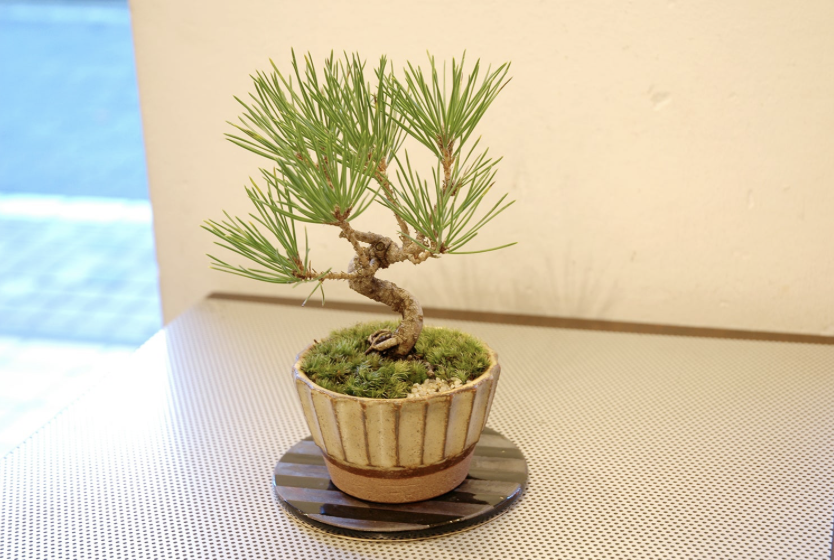
PINE BONSAI CARE GUIDE
Japanese Black Pine Care
PINACEAE / EVERGREEN CONIFER
Japanese Black Pine remains green throughout the year and is highly tolerant
of both summer heat and winter cold.
Hardy and relatively easy to grow, it is one of the most iconic and
traditional species used in bonsai.
PLACEMENT
Where to Place Your Pine
Keep outdoors in a sunny, well-ventilated location throughout the year.
Plenty of sunlight is essential for producing the short, compact needles that give Japanese Black Pine its characteristic appearance.
Keep the tree outdoors where it can receive good sunlight from morning through the afternoon, with plenty of air circulation.
Enjoy it indoors, and set it outside while you are out. Outdoor sunlight and fresh air keep the tree healthy.
WATERING
Watering
Check the moisture level and water thoroughly when needed.
Water thoroughly until water drains freely from the bottom of the pot.
Submerge the moss ball in water for 2–3 minutes. Remove it once air bubbles stop rising.
FERTILIZER
Fertilizing
Feed from March to May and again from late September through October.
Dilute the concentrate 2,000 times with water. As a guide, use 1 mL of concentrate per 2 L of water.
Apply every two weeks.
For a pot approximately 9 cm in diameter, use 2–3 pellets as a guide.
ABOUT MEKIRI
What Is Mekiri?
A traditional technique used to produce shorter, more compact needles.
Mekiri is the practice of cutting off the current year’s elongated shoot, or candle, at its base where it joins the previous year’s branch.
After the candle is removed, a second flush of buds develops. Because these new shoots have a shorter growing period, the resulting needles tend to remain shorter and more compact.
This is one of the traditional short-needle techniques used in the cultivation of Japanese Black Pine bonsai.
MEKIRI & NEEDLE THINNING
Candle Cutting & Needle Thinning
Mekiri is generally performed from mid-June to early July.
By around July, the new candles produced in spring have elongated and their needles have begun to open.
Using bonsai scissors, cut each elongated candle at its base where it joins the previous year’s branch.
About one month after Mekiri, new second-flush buds begin to emerge around the base of the needles and near the cut surface.
Allow the new buds produced after Mekiri to develop. Because their growing season is shorter, the needles produced by these shoots remain shorter than those that began growing in spring.
Once the new needles from the second flush have developed, begin removing the older needles remaining from the previous growth.
Leave the fresh, lighter-colored needles and remove the older, darker needles to complete the seasonal work.
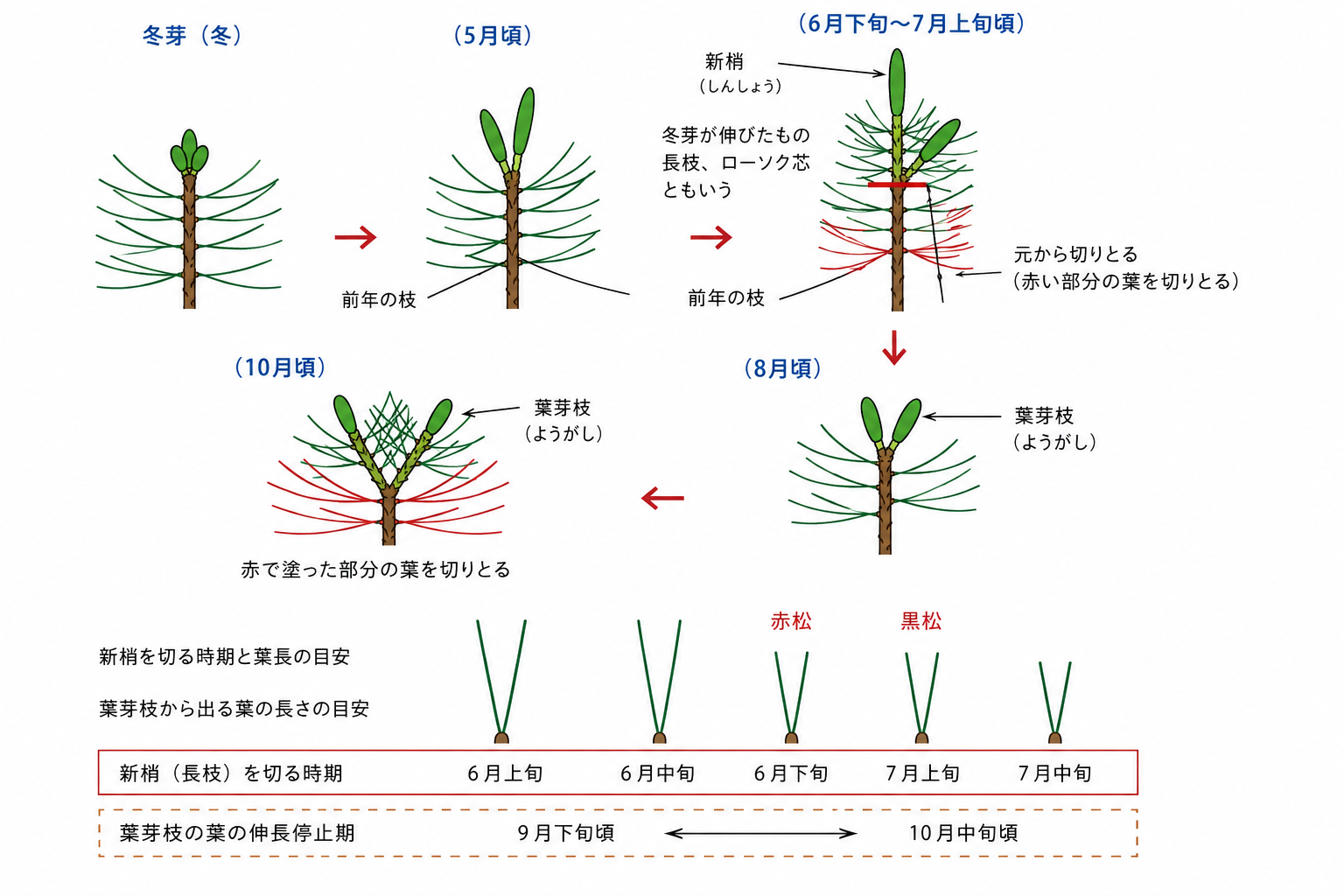
Seasonal cycle of Mekiri and needle thinning for Japanese Black Pine
Cut the elongated candle at its base, where it joins the previous year’s branch.
New buds emerge near the cut and develop into a second flush of growth.
Keep the new needles and remove the older needles from the previous growth.
PINE BONSAI CARE
Plenty of sunlight helps create the compact needles and powerful form characteristic of Japanese Black Pine.
Along with proper sunlight, watering and fertilizing, seasonal Mekiri and needle thinning will gradually help develop the tree into a refined bonsai.